Can You Install an EV Charger in a Townhouse or Condo in BC?
EV chargers can be installed in many British Columbia townhouses and condos, but the approval and electrical design are more involved than in a detached home. The project may affect common property, shared service capacity, electrical rooms, utility billing and future charging access for other residents.
Why strata approval comes first
Parking stalls, parkades, electrical rooms, exterior walls and underground pathways are often common property or limited common property. Even when the stall is assigned to one owner, the wiring route may pass through areas controlled by the strata corporation.
Buying a charger before approval can leave the owner with equipment that does not match the approved system. Start with the strata’s EV policy, bylaws and application form.
What a complete owner proposal should include
The proposal should show the charger make and model, maximum output, parking location, source panel, wiring route, load-management equipment and permit responsibility. It should also explain how electricity will be measured and paid for.
Strata councils often require proof of contractor licensing and insurance, an indemnity agreement, restoration commitment and responsibility for future maintenance. Providing complete information reduces back-and-forth.
Where can the charger get power?
In a townhouse, the circuit may come from the owner’s unit panel when the parking stall and wiring route are nearby. In a condo parkade, the unit panel may be several floors away or located behind a meter arrangement that makes a direct circuit impractical.
Other options include a common-area panel, dedicated EV distribution, meter-connected infrastructure or a networked charging system. The best source depends on building design, capacity and billing requirements.
Electrical capacity must be reviewed at two levels
The electrician may need to assess both the individual unit and the building service. A unit could have spare panel capacity while the common service or feeder is limited. The opposite can also occur.
Technical Safety BC expects the applicable load calculations and project information for EV charging permits. Larger or more complex multi-unit installations may require engineering input.
Load sharing and EV energy management
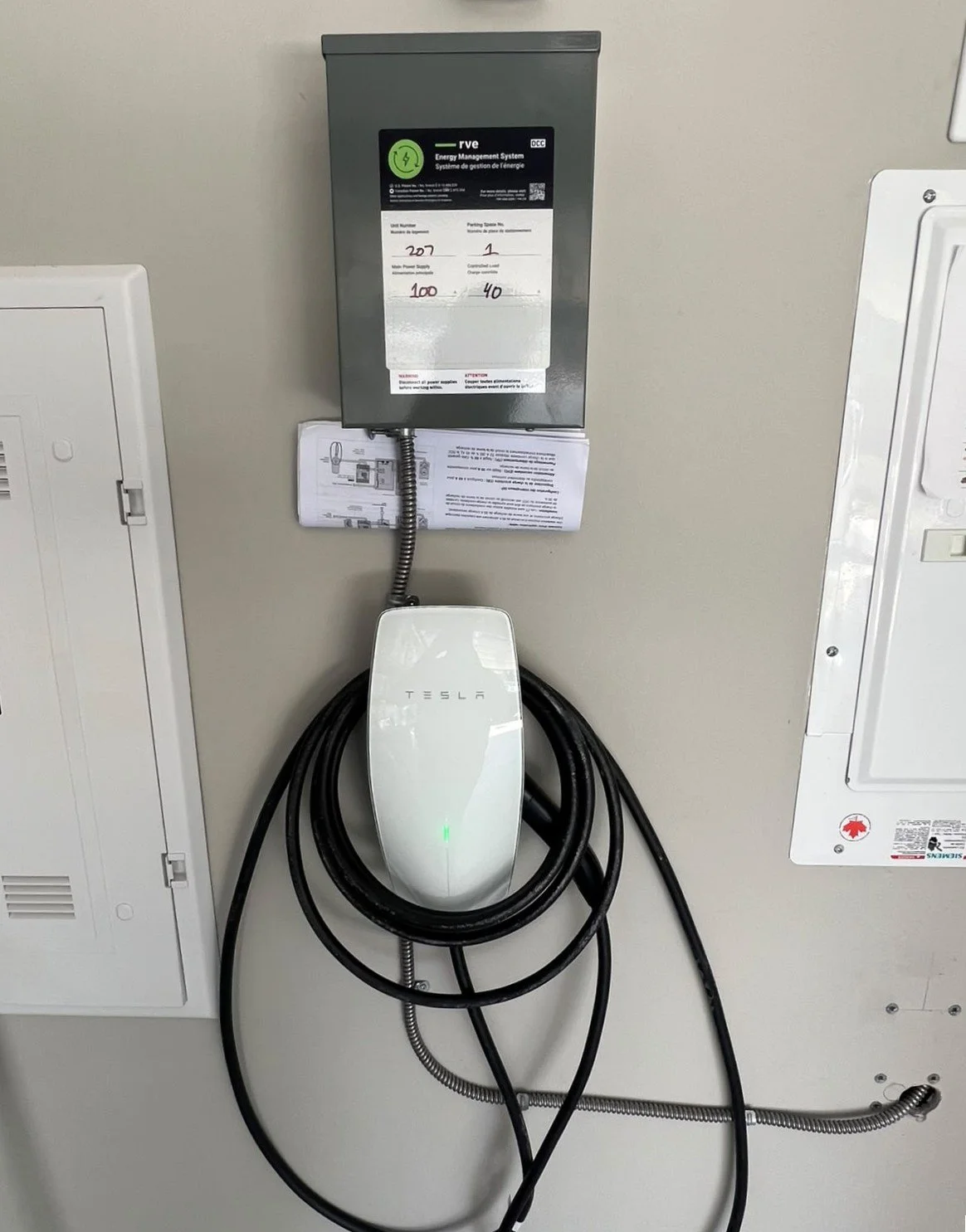
A building may not need enough capacity for every charger to operate at maximum output simultaneously. Networked chargers and EV energy management systems can distribute available power among vehicles.
This approach supports future expansion, but the strata should choose equipment and communication standards carefully. A closed system with ongoing network fees can create long-term operating costs, while unrelated one-off chargers can make future coordination difficult.
How electricity is billed
When the charger is connected to the owner’s unit panel, charging appears on the owner’s regular electricity account. When supplied from common power, the strata needs an accepted method to measure and recover the energy and administration cost.
Options can include network billing, submetering or flat fees, depending on the system and strata policy. The electrical contractor can explain metering hardware, but the strata should obtain legal and accounting advice for its final billing policy.
Long wiring routes and parkade construction
Condo installations may require conduit across concrete ceilings, through fire separations and around mechanical or sprinkler systems. Coring, fire stopping, lift access and restricted work hours add cost.
The route must be approved before pricing is final. A straight-line distance from the panel to the stall does not account for obstacles and permitted pathways.
Townhouse-specific considerations
A townhouse with an attached garage can resemble a detached-home installation, but exterior walls, visitor parking, underground conduits and service equipment may still be common property. Written approval remains important.
If the townhouse has a 100-amp service, an EV load management system may avoid a service upgrade. The strata may require the device to be located and maintained in a specific way.
Charger ownership and maintenance
The agreement should identify who owns the charger, circuit, conduit, network equipment and meter. It should also cover repair, insurance, damage, removal and what happens when the unit is sold.
For shared systems, the strata may own the infrastructure while residents purchase compatible chargers or access. Clear ownership prevents disputes when equipment fails years later.
Planning building-wide infrastructure
When several residents want charging, a building-wide plan is usually better than approving independent circuits one at a time. The strata can assess total capacity, design common pathways and set consistent equipment and billing rules.
Even if only a few chargers are installed initially, conduit and distribution sized for expansion can reduce future concrete work and repeated engineering.
Permit and inspection process
The licensed contractor should confirm whether the project requires an installation permit, how it interacts with any electrical operating permit and what documentation is required. The permit scope should include EVEMS equipment when used.
Keep the permit, drawings, load assessment, commissioning information and owner agreement in the strata records.
What to send for an estimate
Provide the strata EV policy, parking-stall photos, electrical-room and panel photos, unit number, approximate route, charger model and any previous building capacity study. State whether other owners are interested.
A site meeting with the strata manager or council representative may be needed to access locked rooms and confirm the approved route.
Frequently asked questions
Can a strata simply refuse every EV charger?
Strata law and approval duties are legal questions that depend on the circumstances. Owners and councils should obtain current legal guidance rather than rely on an electrician for a legal opinion.
Can I use a regular parkade receptacle?
Do not assume so. Common receptacles may not be assigned, metered or designed for continuous EV charging. Written strata approval and an electrical assessment are required.
Who pays for the installation?
Individual installations are often owner-funded, while shared infrastructure may be funded by the strata or a group of owners. The agreement should define all costs.
Can chargers be added one at a time?
Yes, but the building should have a capacity and infrastructure plan so early installations do not block efficient future expansion.
Lower Mainland electrical service
Planning a townhouse or condo EV charger?
Send the strata requirements, parking-stall photos and electrical information. Hundel Electric can prepare a practical installation scope for the owner and council to review.
This article provides general information for property owners in British Columbia. Electrical requirements depend on the property, equipment, local authority and current code interpretation. A site-specific assessment and the required permit process should be completed before electrical work begins.